


What is Discernment?
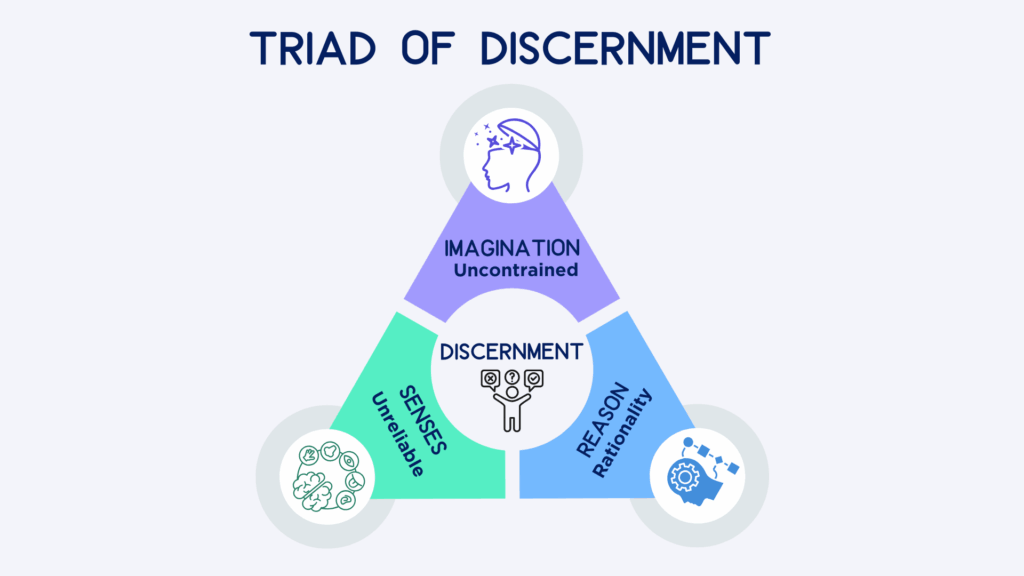
Discernment requires a constant, active negotiation between three competing aspects of human cognition: unconstrained imagination, senses which can be unreliable, and reason. It is the ability to map your senses onto your feelings. It forms the bedrock of judgment. You take an action in the world based on a judgment, and that judgment stems directly from your discernment.
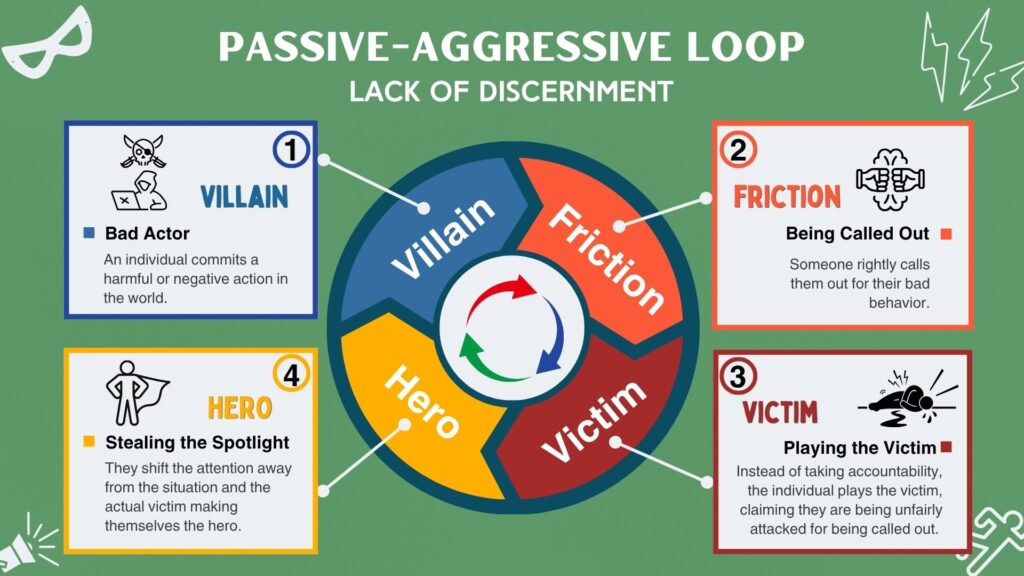
The Passive-Aggressive Loop: Villain, Victim, and Hero
Without discernment, people easily fall into a passive-aggressive cycle where someone can play multiple contradictory roles. The Bad Actor (The Villain): An individual commits a harmful or negative action in the world. Being Called Out (The Friction): Someone rightly calls them out for their behavior, creating necessary friction. The Shift to Persecution (The Victim): Instead of taking accountability, the individual plays the victim, acting as though they are being unfairly attacked for being confronted. Stealing the Spotlight (The Hero): Finally, they pivot the attention away from the actual victim and the situation, by making the drama about themselves, making them the hero.
Measuring Character: Actions Over Words
Discernment requires us to ignore the noise of words and instead observe actions. If someone claims to have a certain set of principles but their actions contradict everything they stand for, then they aren’t a principled person.
Doing the Hard Work
Discernment is difficult. It requires stepping back when your predictions fail. Then you need to examine where your internal models are broken. Finally, you have to accept the conflicts of life rather than whining for an idealized world. Discernment is just hard. Life is a struggle. Do the work!

Associated Terms
Discernment is the ability to map your senses onto your feelings, to tell that there are parts, and to differentiate those parts from other parts and from the whole. It is a constant negotiation and trade-off between your senses, imagination, and logic or reason.
Judgment is a conclusion or decision reached in the world, which stems directly from prior discernment.
Quality is an emotional aspect of assessment that requires external validation and higher-order constraints rather than simple counting.
Quantity is a measurement along a single axis or within a single frame, involving counting and linear precision that can lead to certainty, but fails when applied outside its frame (e.g., confusing income and wealth).
Identity Negotiation is the understanding that identity is not a fixed, singular label or something you entirely pick for yourself, but rather a dynamic process that transcends small measurements and is defined by actions rather than words.
Projection is a psychological phenomenon where, due to a lack of discernible boundaries and a fragile ego, a person takes their own internal imagination and fills empty space by projecting it outward onto others.
Mimicry is an unconscious or semi-conscious reaction to inputs outside of yourself, often driven by a desire to avoid conflict or make peace through empathy.
Egregore is distributed cognition. It is bigger than any single individual, such as distributed cultural knowledge.